
Chronic wasting disease (CWD) is a degenerative neurological disease that belongs to a family of diseases called transmissible spongiform encephalopathies (TSEs). CWD is found in members of the cervid family (deer, elk, moose, caribou, etc.).
CWD is caused by prions, which are an abnormal type of protein. Prions cause otherwise normal proteins to misfold and become prions themselves. As prion concentrations increase, animals suffer neurological decline and eventual death. There are currently no known treatments or cures for the disease.
What are the symptoms?
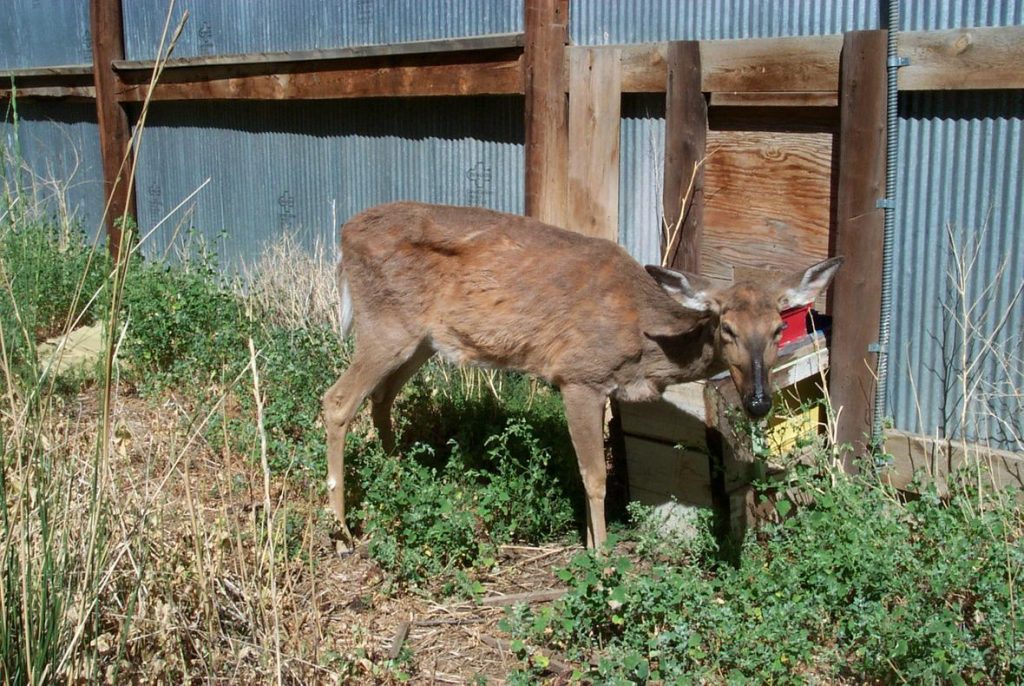
Often, infected animals show no outward signs of illness. Disease incubation can take up to 4 years before visible symptoms appear. In late-stage infections, symptoms include:
- Emaciation
- Drooping head
- Excessive drooling
- Lethargy
- Disorientation
How does it spread?
CWD can spread directly, through contact between sick and healthy animals, or indirectly through contact with infected material. CWD prions can persist in the bodily fluids and remains of infected animals, as well as in the environment. CWD prions remain infectious for years.
How does it impact the population?
CWD is 100% lethal to cervids. While the lengthy incubation time means it may go undetected within a population for years, the disease is spreading. As CWD prevalence within a population increases, individual lifespan decreases and ultimately populations decline.
Is it dangerous to humans?
There have been no known cases of CWD transmission to humans. However, TSEs do include some human diseases such as bovine spongiform encephalopathy (mad cow disease). The Centers for Disease Control and Prevention do not recommend the consumption of meat from animals that test positive for CWD.
Where is it?
As of September 2023, CWD is present in 31 US states and 4 Canadian provinces. CWD is present in both captive and wild cervid populations. CWD was detected near Libby, MT in 2019 and near Lucile, ID in 2021. At this time, CWD has not been detected on the Coeur d’Alene Reservation.


What can I do?
Report any abnormal behavior or sick animals to Fish & Wildlife.
If you are a hunter:
- Do not transport carcasses from areas with CWD infection
- Wear latex or rubber gloves when processing an animal
- Avoid handling brain and spinal tissues
- Disinfect game processing and transport equipment with bleach
- Get your harvest tested for CWD through Fish & Wildlife
What is the Fish & Wildlife Program doing?
CDAT Fish & Wildlife staff are actively monitoring for CWD on the Reservation. Samples collected from roadkill and hunter-harvested animals are tested for CWD. We strongly encourage hunters to bring in their animals for testing, or to submit samples themselves.
Watch a video on taking samples yourself
If CWD is detected on or near the Reservation, there is a response plan in place. Please contact us with any questions or concerns.
Other useful links
- Chronic Wasting Disease Alliance https://cwd-info.org/
- IDFG CWD page https://idfg.idaho.gov/cwd
- WDFW CWD page https://wdfw.wa.gov/species-habitats/diseases/chronic-wasting
- USGS CWD page https://www.usgs.gov/centers/nwhc/science/chronic-wasting-disease